
Fake News?: Migrant Mother and How Her Story Was Changed
It’s 1936, America is still reeling from the effects of the great depression and Dorothea Lange is returning home from her latest assignment, documenting the hardships of farmers in the dustbowls of California and Oklahoma.
Lange is most of the way home when she has a feeling, a compulsion as she’s describes it, to turn around and return to the pea pickers farm she passed 20 miles back.
And it’s there, she discovers, and makes the image, Migrant mother. Unbeknownst to Lange and her subject an image which would become the symbol of desperation, of motherhood and of the state of working class Americans in the 1930’s.
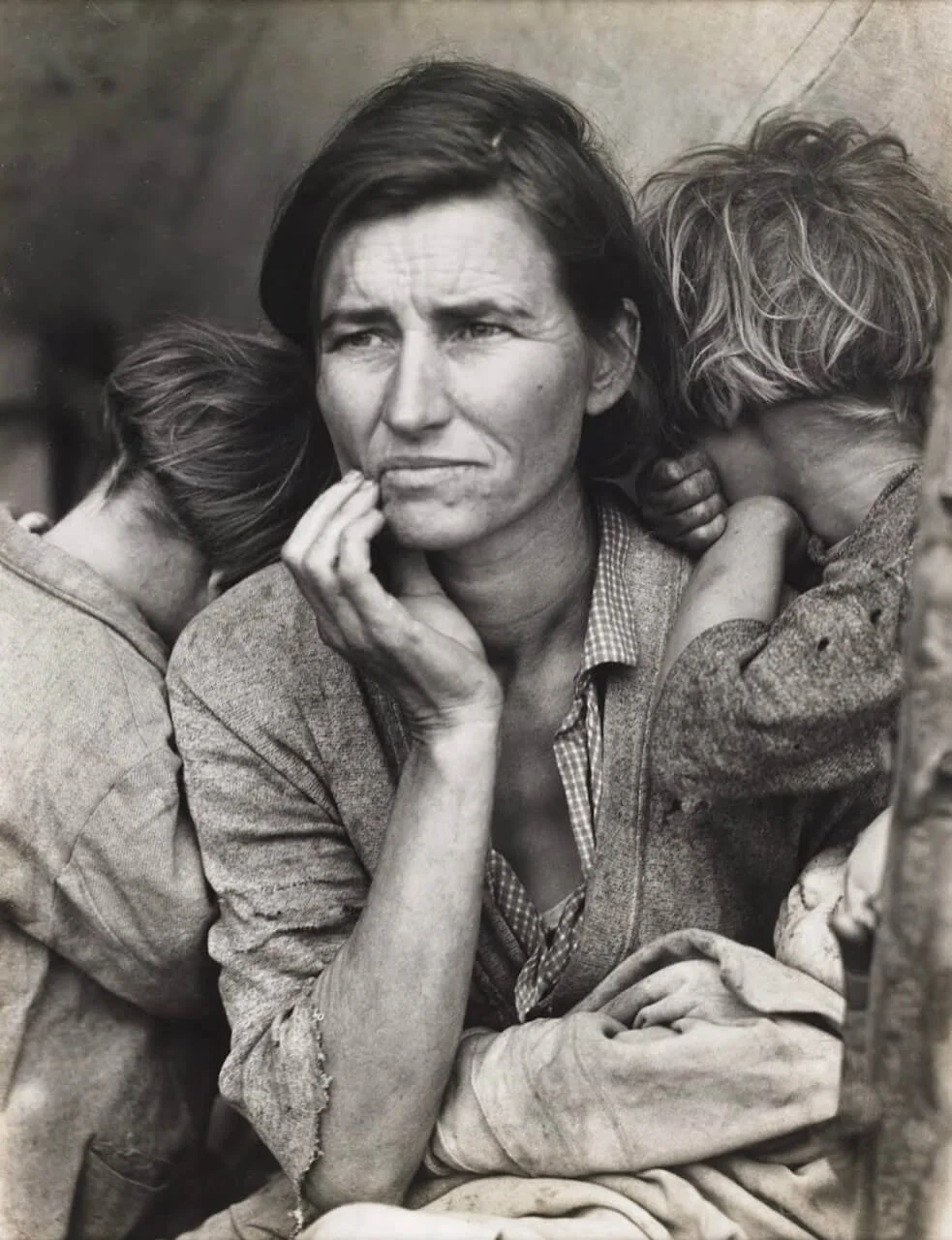
Migrant Mother, Nipomo, California. Lange, D (1936)
Lange describes making the image in a short 10 minute visit to the camp, A mother was there with her three young children crowding together next to then remains of their car, now unusable due to having to sell the tyres in order to feed her family. She looks on wistfully, troubled, wondering how as a single mother in the greatest economic collapse at that time, they will survive.
At least that’s the story she provided her editor when she submitted that now iconic image to her editor and repeated again in many interviews and exhibition catalogues.
The truth however is, as with many things, much more mundane.
Who was the mother shown and what was her experiences of the depression? Is it true that our ‘mother’ here was struggling to survive?
What if the story we were told was an example of ‘fake news’?
TO understand why we have a conflict between what the image represents and the actuality of who and what is shown, we need to understand how this image came to be made and also ask the questions does it matter that it’s not exactly ‘true’?
Migrant Mother, Nipomo, California, has come to be symbolic of, and synonymous with the Great Depression.
A period of time marked by the stock market crash of October 1929 through to the initiation of New Deal programs by then President Roosevelt in March 1933.
Programs intended to support the rejuvenation of working class farming, manufacturing and general employment opportunities.
The Great Depression marked the worst economic recession in history, millions became unemployed and global gdp plummeted. Mass migration, homelessness, poverty and illness where widespread and unforgiving.
The effects of the recessions lasted much longer than the official period of depression and Roosevelt’s plans didn’t change the circumstances overnight.
As part of that New Deal package of initiatives, 1935 marked the forming of the Resettlement Administration. The R.A. was formed in order to assist farmers in transitioning into more viable and profitable business models. A process which was regularly challenged by conservative politicians as being interventionist or socialist.
In 1937 the RA became part of the Department of Agriculture and was renamed the Farm Securities Administration. Both the RA and the FSA understood the power of photography in documenting the agency’s actions. Roy Stryker was in charge of the photographic department for the RA and transitioned when the agency became the FSA.
Stryker was well verse in the use of photography in Press, whilst there was a sense of freedom for the photographers under his direction to pursue their own interests and styles, Stryker still provided briefings and assignments designed to best represent the agency, and most effectively communicate its’ goals.
Many of Stryker’s photographers were art educated, experienced with assisting or working with 19th century documentary photographers came from backgrounds which gave them the insight and experience to investigate the effects of the depression. Many went on to become household names, Walker Evans, Dorothea Lange, Gordon Parks, Esther Bubley, Russell lee, and many others.
Their work for the FSA often leading to widespread recognition and influencing the genre of documentary for the next 100 years.
However varied the photographer, every images produced passed through the hands of Stryker, who would select the cream of the crop and distribute to press agencies to support the articles provided alongside the images, to be turned in to advertisements and importantly to illustrate the reports which were provided to congress and used by lobbyists to continue securing funding for the program.
Migrant Mother, made in 1936, was one of those selected.
Lange’s image was use in advertisements, reports and news articles.
Each time it was contextualised with the subjects story, a story which, in combination with all the work of the FSA, shifted the publics perception of the New Deal programs and dramatically increased the support from congress and importantly the opposing political voices.
The story that she discovered the ‘Mother’ of this photograph on the journey home to San Francisco became part of the contextualisation and mythology distributed alongside the image and retold many times in it’s future publication and exhibition.
As described by Gerry Badger in “The Genius of Photograhy”
“She passed a sign that read’ Pea-Pickers’ Camp’ and drove for another twenty miles, before something compelled her to turn back and visit the camp.”
Migrant Mother’s contextualisation included
“March 10, 1936, under the heading: "Ragged, Hungry, Broke, Harvest Workers Live in Squalor."
Or
"What Does the ‘New Deal’ Mean to This Mother and Her Child?"
The story of the subject selling the tryes on her car in order to feed her children persevered, along with Langes story of being compiled to visit the pea pickers camp.
And even later on, their were claims being made about how the image affected the Mother…
“In the catalog accompanying a recent Lange exhibit at the San Francisco Museum of Modern Art, exhibit curator Sandra Phillips argued that Florence Thompson’s "life [was] most likely saved by Lange’s photo."
As you can see from these headlines and even in Badger’s excerpt, Lange is given an otehrowrldly power, she’s not fulfilling a brief but rather some force is compelling her to return and make a photo, in order to miraculously save this family from the struggles of poverty.
But both Badger, Marien and Phillips omit addressing the major issues with the story.
Where Marien does reference the fact that Lange had a retoucher adjust aspects of the final image, an act which could have been claimed as manipulating the ‘documentary’ validity. All fail to address the fact that the Mother herself came forward many years later to deny the story Lange had told.
Florence Owens Thompson, is our Mother.
Florence was a widow with eight children, her first six with her deceased husband, her seventh with an influential man who she left due to fearing having her child taken from her and her eighth in 1935 with a man who Florence effete had no ability to support their family. Having taken on the responsibility of supporting her family Florence was travelling to find work and a better place to live.
A combination of mysigonistic views of single parent women, a fear of taking government support due to the implications it would have on maintaining parentship of her children and the depression nesecitating the needs to migrate.
The image we now recognise was taken after her car broke down on the long journey, and whilst her eldest sons were at the nearby garage getting parts repaired.
To her the photographer was just an unusual occurrence on the journey, mother to be thought of again and quickly forgotten about.
Lange made six images, each one moving closer to the subject until making the image we recognise now, the close, intimate proximity, the close framing which places the whole family tightly together clinging to mother as the subject herself looks on wistfully and with considerable contemplation.
“…the others in the sequence demonstrate that even fashioning a meaningful documentary picture is an art- one that Lange was rather good at.”
Gerry Badger here alludes to the process of selection and refinement, the searching and finding of the composition and framing which heighten s the image from recording a scene and into iconography.
This iconography has been replicated many times since, it’s been described as being religious, and with reference to the obvious similarity between migrant mother and the images of the Virgin Mary.
It wasn’t until Many years after the initial success of Migrant Mother, that Thompsons sons responded to an interview request. Answering many of the questions raised by this photograph.
Addressing the idea that the image lead to an outpouring of support for Thomson when it initially published, Troy Owens one of Florenece’s sons answered,
"We were already long gone from Nipomo by the time any food was sent there," said Owens. "That photo may well have saved some peoples’ lives, but I can tell you for certain, it didn’t save ours."
For Florence, the idea that she would need to sell her tyres to support her family was an insult to her skills as a mother. Thompson took great pride in supporting her family and it’s perhaps this which stopped her coming forward after the images became famous. Pride rejecting the concept of the photogra[h.
Thimpsons son’s were a little more forgiving, providing Lange the benefit of the doubt and describing the story as most likely a mix up between theirs and another families rather than an outright fabrication.
Unfortunately, despite the image becoming perhaps the most recognisable images of the 20th century, the truth was it had little impact on Florence Owens Thompsons fortunes.
Struggling for years to support her family as her image became more and more popular and influential. Travelling the world vicariously as her face was displayed in exhibitions.
In 1983 Thomspon was diagnosed with cancer, at the age of 79. Her care became essential, requiring 24 hour attention and ultimately becoming unwieldy expensive for her family to continue.
In response to this news nearly 2000 letter were received from memebers of the public pledging support.
"None of us ever really understood how deeply Mama’s photo affected people,"
Florence died on Sept 16th 1983, shortly before her 80th birthday.
Her legacy unfortunately will no doubt be washed away with time as the story of Migrant Mother overpowers it. The truth of the image only becoming revealed by those who seek it out.
But in doing so her legacy will also continue to have the impact it had in 1936.
As a subject of a timeless and iconic photograph, Florence represented the struggles and problems of hundreds of thousands of Americans. The image can without doubt be attributed with having a huge impact on the perceptions of the social support that Roosevelts government was delivering. Resulting in increasing support for initiatives like those the FSA put forward.
SO we return to the question I won’t answer. DO the ends support the means?
A more ‘truthful’ story and any other of Lange’s six images may have made Thompson happier with the outcome but would it have become the symbol of struggle that touches people even now nearly 100 years later? Would the New Deal initiatives received the continued support that this image and the others presented by the FSA undoubtedly helped to foster? Without the impact of these images how many people would have suffered longer and harder?
Let me know what you think in the comments...
Thank you
If you enjoyed this post you may also enjoy my other work…
Photography
Art Instagram - https://www.instagram.com/harleybainbridge
Commercial Instagram - https://www.instagram.com/harleybainbridgephotography
Website - https://harleybainbridge.com
Linktr.ee - https://linktr.ee/Harleybainbridge
————————————————————————
Podcast
Apple Podcast - https://podcasts.apple.com/us/podcast/before-the-shutter-with-harley-bainbridge-photography/id1505076540
Google Podcasts - https://podcasts.google.com/feed/aHR0cHM6Ly9hbmNob3IuZm0vcy8xMTQzNzNiMC9wb2RjYXN0L3Jzcw
Spotify - https://open.spotify.com/show/7wD3XvzbJTQTCWtlA5y9Xd?si=e5c4e6e8a0914060
—————————————————————————————-
Additional References
https://www.history.com/topics/great-depression/artists-of-the-new-deal?li_source=LI&li_medium=m2m-rcw-history#&gid=ci023c13a630002602&pid=1_nypl_57578572_dust_bowl_dorothea_lange
https://www.anothermag.com/art-photography/10948/why-photographer-dorothea-langes-political-legacy-continues-to-endure
https://www.history.com/topics/great-depression/new-deal#&gid=ci0230e630b05726df&pid=by-vera-bock-2
https://en.wikipedia.org/wiki/Franklin_D._Roosevelt
https://www.thebalance.com/the-great-depression-of-1929-3306033
https://www.thestreet.com/politics/great-depression-causes-14663720
https://www.researchgate.net/figure/Resettlement-Administration-poster-from-the-1930s_fig1_271658485
https://www.loc.gov/item/toddbib000400/
https://www.britannica.com/place/United-States/The-second-New-Deal-and-the-Supreme-Court
https://edition.cnn.com/2008/LIVING/12/02/dustbowl.photo/
https://www.dailymail.co.uk/news/article-2290879/I-lost-hope-Startling-interview-unearthed-woman-iconic-Great-Depression-image-talking-just-years-death-1983.html
https://www.seattletimes.com/business/the-depression-shattered-and-changed-america-now-history-may-rhyme/
https://www.moma.org/momaorg/shared/pdfs/docs/learn/courses/sarah_meister_migrantmother_excerpt.pdf?utm_medium=email&utm_source=other&utm_campaign=opencourse.-qAWU5qYEeWdIQqYUkH3aw.announcements~opencourse.-qAWU5qYEeWdIQqYUkH3aw.T38CBwq2EemVMAqq9S7Vig
https://www.moma.org/artists/3373
https://en.wikipedia.org/wiki/Roy_Stryker
https://en.wikipedia.org/wiki/Walker_Evans
https://en.wikipedia.org/wiki/Gordon_Parks
https://en.wikipedia.org/wiki/Esther_Bubley
https://artsandculture.google.com/asset/migrant-mother-nipomo-california/ogF9bKF6G1Kwlg?hl=en-GB&ms=%7B%22x%22%3A0.5%2C%22y%22%3A0.5%2C%22z%22%3A9.465749427094995%2C%22size%22%3A%7B%22width%22%3A2.573051996603347%2C%22height%22%3A1.2375000000000014%7D%7D
https://eportfolios.macaulay.cuny.edu/lklichfall13/files/2013/09/Lange.pdf
https://en.wikipedia.org/wiki/File:Additional_image_from_Migrant_Mother_series,_from_Oakland_Museum_Collection_01.jpg
https://en.wikipedia.org/wiki/File:Migrant_agricultural_worker%27s_family,_Nipomo,_California_ppmsca03054u.jpg
https://en.wikipedia.org/wiki/File:Additional_image_from_Migrant_Mother_series,_from_Oakland_Museum_Collection_02.jpg
https://en.wikipedia.org/wiki/File:Migrant_Mother_1936_2.jpg
https://en.wikipedia.org/wiki/File:Migrant_Mother,_alternative_version_(LOC_fsa.8b29523).jpg
https://en.wikipedia.org/wiki/File:Migrant_Mother_sequence_by_Dorothea_Lange,_8b29525u.jpg