Bourdin: Idolised by Woodman?

fig. 1
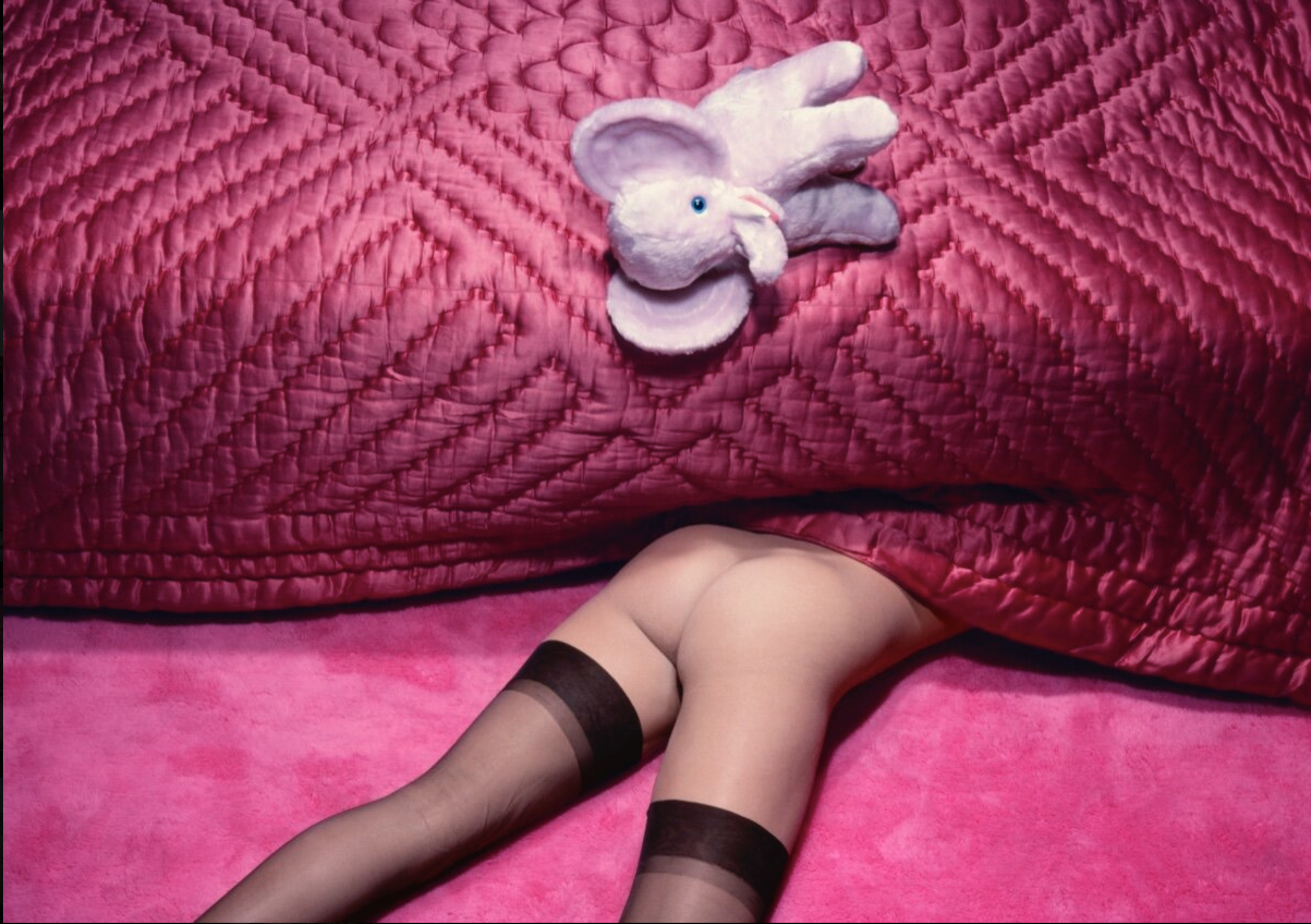
fig. 2
My selection of Francesca Woodman for this comparison was influenced by a recent article from the BBC which revisits her work ahead of the new Marian Goodman gallery in New York exhibition of her work.
Revisiting Woodman I decided to look back at some of the other works I have previously reviewed and in doing so was surprised to find through the Tate website that Woodman supposedly idolised Guy Bourdin and his fashion work, understandable to a certain extent when considering her aspirations as a fashion photographer but surprising in the difference of approach to their work.
I selected these two images to contrast their approaches and the significant difference of outcome.
Woodman here is depicted in a black and white self-portrait, both typical of her work. The camera is positioned above Woodman and looks down to her positioned on all fours, partially dressed and on top of a mirror, her rear quarters positioned out of the upper portion of frame, whilst her face is in the lower quarter turned up towards the camera, slightly burred in movement. Under the main image, and by hand in ink is the caption;
"See you Sunday
Bow Wow
love
Spot"
Whilst many of the specific markers of Woodman style are all here, black and white, movement blur, self-portrait, hand written notes and small format loose mounted print, the usual melancholic tone is absent. Instead we see a playful pose, a knowing look and sweet reference to nick names and roles, intimate and warm despite the subservient position Woodman displays. Perhaps its the knowledge of her role as photographer that gives her agency in this image, or perhaps its the fact we get the intention, the image is the kind of personal and intimate sexiness that only occurs between comfortable and confident lovers, without Woodman actually revealing anything. As with many of Woodman's other works, the power in the image is in what we don't see.
Bourdin's in contrast is almost the diametric opposite of Woodman's.
Know for provocative, highly sexualised, sensual and minutely crafted fashion and advertising imagery, Bourdin's image shows us everything Woodman's doesn't.
Bourdin's most prominent model Nicolle Meyer explains that her "...favourite image is the one that Samuel gave me to thank me for all my help - the Pentax ad with the toy elephant. The pink quilted bed cover and my bottom sticking out from under the bed. You can’t tell it’s me, but the image is iconic and immediately grabs your attention."
My reaction to this image is immediately of objectification. The figure in this image is powerless in the exchange, unaware of the photographers gaze, caught in a defenceless position and apparently, judging by the toy placed on the bed, of a young age, one could even say an age in which consent to such an image is not possible. The image plays directly into the concerns of Sontag, the male voyeur hunting for trophies, somewhat ironic that the epitome of problematic photography is an advert for, at the time, one of the largest camera manufacturers. Meyers selection of this image as one of her favourites is, in a way, condoning the image, it is attention grabbing, the bold colours no doubt suggest the Pentax's ability to create vibrant images, the partial nudity edges on the borders of acceptability in advertising standards and the idea of catching a subject unawares speaks to the power and capability of the equipment but ultimately it is the male gaze personified. A female subject stripped of all agency and reduced to a pair of suggestive limbs, no face to deny permission. Meyer's comment would suggest the idea of internalised misogyny is what justifies the outcome for her.
And that is why I find it so hard to believe that Woodman idolised Bourdin. Woodman's image suggestive without being explicit, her consent and involvement are prominent within the frame and the intimacy supports the consent despite the break down of privacy in publishing the image. For all it's playfulness, it's as if in this image, Woodman dares you to objectify her.
Thank you
Hey, thank you for taking the time to read this essay
If you have enjoyed this one you may like the rest of my blog in which I discuss many different images and artists
You may also like my own photographic work which you can find at;
www.harleybainbridge.com and @harleybainbridge on instagram
Image Reference
Figure 1. Tate. (s.d.) ‘Untitled, Providence, Rhode Island’, Francesca Woodman, 1975–6.
Figure 1. ARTWORKS. (s.d.) https://www.guybourdin.org/artworks?itemId=2r05raj47imvb6t9hmd9v8liqlq3u0
Bibliography
A Message For You. Re-SEE sits with Nicolle Meyer who reflects on the magical years working with Guy Bourdin, she remembers his artistic genius and her role in transporting his legacy to future generations. . (s.d.) At: https://www.resee.com/en/blog/a-message-for-you-guy-bourdin-and-his-muse (Accessed 13/01/2024).
ARTWORKS (s.d.) At: https://www.guybourdin.org/artworks (Accessed 02/01/2022).
Dickson, A. (s.d.) Francesca Woodman: The eerie images of a teenage genius. At: https://www.bbc.com/culture/article/20211209-francesca-woodman-the-eerie-images-of-a-teenage-genius (Accessed 02/01/2022).
Tate (s.d.) Francesca Woodman 1958–1981. At: https://www.tate.org.uk/art/artists/francesca-woodman-10512 (Accessed 02/01/2022a).
Tate (s.d.) ‘Untitled, Providence, Rhode Island’, Francesca Woodman, 1975–6. At: https://www.tate.org.uk/art/artworks/woodman-untitled-providence-rhode-island-ar00347 (Accessed 02/01/2022b).